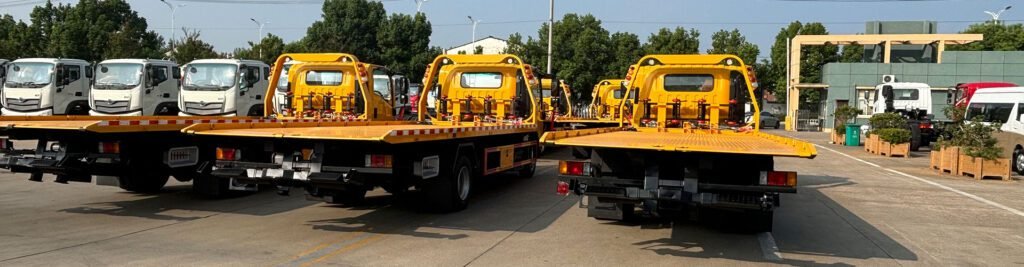
I. Definition and Functions of Wreckers
On bustling city streets, wreckers are among the most common specialized vehicles, possibly even more frequent than sanitation trucks. As essential tools for handling disabled vehicles, urban Violation vehicles, and emergency rescue operations, wreckers are equipped with various devices such as lifting, towing, and hoisting systems. Their core mission is to quickly and safely move accident-damaged or broken-down vehicles from complex environments—including road surfaces, roadbeds, or even areas below the roadbed—to repair shops or parking lots, ensuring timely assistance and rescue for drivers and their vehicles, thereby effectively maintaining road traffic safety and smooth flow.
Wreckers play a vital role in road rescue, yet they also serve another indispensable function—transporting commodity vehicles. Since unlicensed vehicles are strictly prohibited from road use, the transportation of commodity vehicles from 4S stores to secondary networks, or from suburban warehouses to 4S stores, must rely on wreckers. In fact, the frequency of wreckers being used for commodity vehicle transfers now surpasses their application in road rescue.
II. Development History of Wreckers
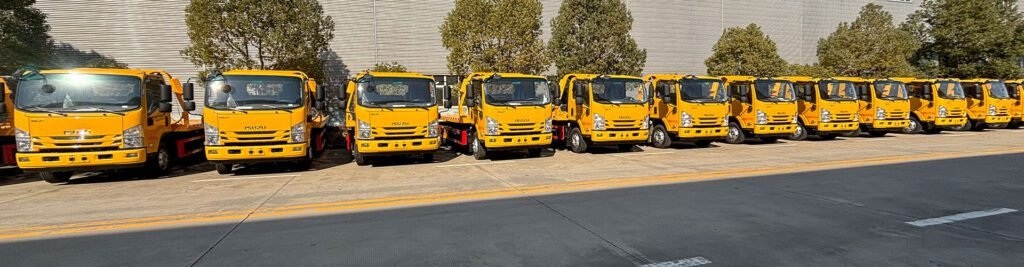
II. Development History of Wreckers
Road clearance and rescue technology began in the early 20th century in the United States. Initially, people equipped trucks with pulleys, steel cables, and winches driven by mechanical transmission. Using lever supports, one end of the disabled vehicle was lifted and towed away. Although these technical methods had limited functionality, they laid the foundation for the development of wreckers.
Subsequently, from the 1920s to the 1950s, this technology underwent initial development stages. Wreckers saw improvements not only in functionality but also in structural design and material selection. These enhancements allowed wreckers to perform road rescue tasks more efficiently and laid a solid foundation for their application in commodity vehicle transport.
The Second Stage: 1950s–1970s
The introduction of hydraulic transmission and control technology marked a significant breakthrough in wrecker technology. With the production of the first fully hydraulic transmission wreckers, numerous well-known wrecker manufacturers emerged. During this stage, wrecker craftsmanship advanced significantly, with increasing varieties, specifications, and diverse structural forms. Choices for specialized chassis and Category II chassis also became more abundant.
The Third Stage: 1980s to Present
Wreckers entered a period of rapid development. During this stage, wrecker structures diversified, and functionalities became increasingly comprehensive. In addition to basic functions like lifting, hoisting, towing, and traction, new features such as back-towing were added, enabling wreckers to handle various complex situations with greater ease.
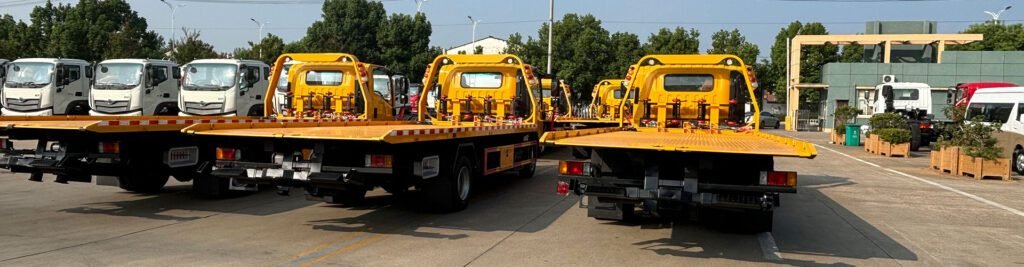
III. Classification of Wreckers
Wreckers can be categorized by type into: integrated lift-and-tow, separate lift-and-tow, flatbed two-carriers, 360-degree rotating hoist, and hydraulic automatic clamping types. These different types of wreckers vary in structure and functionality, contributing to the rich diversity of the wrecker market.
Wreckers can be further subdivided by structural form into: towing type, loading type, hoisting type, and rescue type (including single-arm and double-arm) wreckers. These subtypes differ in specific structure and function, providing diverse options for addressing various road obstacles and rescue needs.
Beyond structural form, wreckers can also be classified by operational capability into light-duty, medium/heavy-duty, and super-heavy-duty. Light-duty wreckers primarily handle light-duty trucks, micro-buses, and cars. Medium/heavy-duty wreckers focus on medium/heavy-duty trucks and large/medium-sized buses. Super-heavy-duty wreckers primarily handle heavy-duty trucks and ultra-heavy-duty semi-trailer series. This classification allows wreckers to better adapt to different road conditions and rescue requirements.
Furthermore, based on usage characteristics, wreckers fall into two main categories: carrier type and hoist-towing type. Carrier-type wreckers are mainly used to tow damaged vehicles onto the carrier for transport. Hoist-towing type wreckers use their onboard hoisting and towing devices to lift or hoist one end of the damaged vehicle off the ground while the other end remains on the ground, subsequently towing it away via the hoist-towing wrecker. This classification provides flexibility for various road conditions and rescue needs.
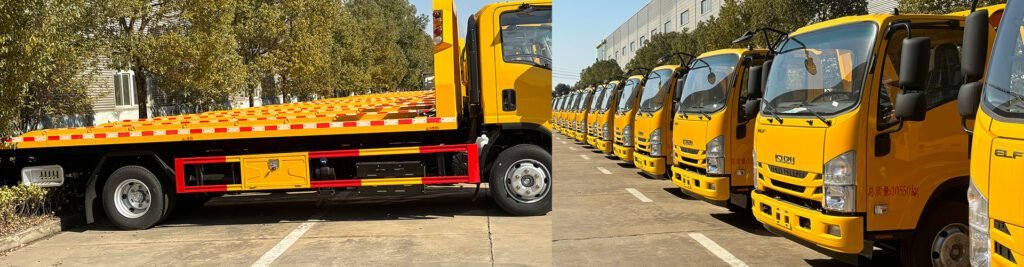
IV. Functions and Uses of Wreckers
Wreckers, designed specifically for disabled vehicles, urbanviolation vehicles, and emergency rescue, have become essential tools in road rescue and urban management due to their unique functions and wide range of uses.
Lifting Function: A core function is lifting. Through the extension and retraction of the tow arm, it easily lifts and tows away damaged vehicles, whether from the front or rear.
Hoisting Function: Tow-and-lift wreckers are equipped with variable-amplitude booms, capable of easily hoisting and righting damaged vehicles, providing strong support for lifting operations. Heavy-duty wreckers can use boom extension/retraction and amplitude variation to pull or hoist accident vehicles from the roadbed or nearby locations onto the road surface.
Pulling/Dragging Function: Equipped with winches, the main boom and on-site anchor pads, they can perform righting and pulling operations for various overturned vehicles, even those in deep ditches.
Towing Function: Once a vehicle is lifted, the wrecker can tow it away. Additionally, for vehicles with intact axles, the wrecker can tow them using a tow bar.
Back-Loading (Carrier) Function: Flatbed wreckers can pull accident vehicles onto the flatbed and secure them via soft-contact fixation for damage-free transport, particularly suitable for passenger vehicles.
Warning and Lighting: Wreckers are equipped with large warning lights and sirens to provide clear markers for operations. Their auxiliary rescue lighting is also suitable for nighttime work.
V. Current Status and Future of Wreckers
China’s wrecker production began in the late 1980s. After nearly 20 years of development, progressing from importing complete vehicles to independent research and development, the wrecker industry has made remarkable strides. With the rapid development of urban transportation and expressways, product design technology and manufacturing processes for wreckers have also achieved breakthrough progress. Looking ahead, wreckers will develop towards multifunctionality, intelligence, and user-friendliness. Simultaneously, chassis specialization, heavier duty capacities, and the practicality of operational devices will become new trends in technological development. Companies like Qiande Solutions are actively contributing to these advancements, focusing on innovative and reliable wrecker solutions.
VI. Overview of Domestic Wreckers Manufacturers
In the 2020 market landscape, 78 wrecker manufacturers achieved sales. Notably, the top eight companies held a market share of 62.53%, reflecting an “oligopolistic” market structure with relatively high concentration. In this competitive environment, industry leaders like Chengli Special Vehicle, Guangdong Yuehai, and XCMG maintained dominant market positions through excellent product quality and market strategy.
Two major factions have emerged in the wrecker market. Guangdong Yuehai, representing the Guangdong faction, holds a leading position in the domestic wrecker market with its superior product quality and market performance. Its market share exceeds 45%, benefiting from advanced body manufacturing processes and quality service, winning trust from numerous domestic and international clients. Simultaneously, the Hubei Suizhou faction has garnered attention with its unique market strategies and product advantages, securing a place in the fierce market competition. Suizhou, a vital birthplace and production base for China’s special purpose vehicles, also demonstrates considerable strength in the wrecker field. It is home to over ten medium/heavy-duty modification enterprises, such as Qiande Solutions, Sinotruk Huwei, Hubei Chenli, Xiamen Gong Chu Sheng, Hubei Runli, and Hubei Heli, collectively driving the prosperity and development of the wrecker market.
VII. Wrecker Selection Guide
When selecting a wrecker, it is essential to closely consider the actual operating environment. For auto repair shops and traffic departments, choosing wreckers suited to their respective needs is crucial. Traffic wreckers should meet specific job requirements, ensuring the selected product is rational and practical. Key points to consider when selecting a road wrecker include:
Determine wrecker classification based on operational requirements.
Configuration requirements for wreckers vary across different operational environments. For instance, traffic volume and vehicle composition differ on various expressway sections: some sections have more medium-duty trucks and long-distance buses, while others have a higher proportion of medium/heavy-duty trucks. Consequently, wrecker configurations need adjustment: the former should focus on medium/heavy-duty wreckers equipped with devices capable of handling large buses; the latter should choose super-heavy-duty wreckers to address different challenges. Similarly, for urban traffic police departments, the types of violation vehicles vary by region: some areas may need to remove more violation motorcycles, while others primarily deal with violation cars. To address these differences, the former should select wreckers equipped with motorcycle lift platforms, and the latter should choose clamp-type wreckers for more effective enforcement.
Technical Parameter Standards
According to new wrecker standards, maximum lifting capacity and maximum towed mass are key indicators for measuring a wrecker’s operational capability. The maximum towed mass must be within the chassis’s maximum designed gross vehicle mass. The maximum lifting capacity, i.e., the rated lifting capacity at the tow arm’s minimum effective length, must meet specific axle load requirements. These ensure that in the towing state, the front axle load is at least 15% of the maximum gross mass, and the rear axle load does not exceed 20% of its permissible load. Additionally, the front axle load when unloaded must not exceed its permissible load. Furthermore, the ratio of the wrecker’s lifting capacity to its towed mass should not be less than 20%. Adhering to these regulations allows for assessing whether a manufacturer’s stated technical parameters are accurate and compliant. The maximum lifting capacity is a key parameter for evaluating operational performance, clearly defined in standard QC/T 645-2004. The standard specifies that the rear axle load in the maximum towing state must not exceed 20% of its permissible load to ensure the wrecker’s safety and stability. These regulations enable rational vehicle overall layout or increasing the maximum lifting capacity by adding counterweight at the front of the chassis.
Standard vs. Optional Configurations
Standard configuration refers to the essential equipment required for the wrecker to perform its basic clearance and rescue tasks, as defined within the standard’s scope. Optional configurations offer greater flexibility, allowing users to select different components to replace standard parts or purchase additional operational attachments to enhance the wrecker’s functionality. For example, the hydraulic system can use imported or domestic components, and operational auxiliary wheels can be purchased to further improve capability. Qiande Solutions can provide expert guidance on selecting the most suitable configuration based on specific operational needs and budget.
VIII. Wrecker Maintenance and Care
To ensure the long-term stable operation of a wrecker, a reasonable maintenance plan must be established, and the equipment should be inspected and maintained regularly. Excessively worn or damaged parts should be repaired or replaced immediately to ensure vehicle safety and performance. During operation, any damaged or missing parts must be handled with caution; the vehicle must not be used without repair and replacement to avoid potential safety risks.
Furthermore, personnel who have not read the manual or received specialized training are strictly prohibited from operating the wrecker or performing clearance and rescue work. If problems arise and operational experience is lacking, do not arbitrarily adjust or disassemble the equipment, especially the hydraulic system. It is recommended to contact the local after-sales service center or directly reach out to the manufacturer’s after-sales department for assistance from professionals.
When understanding the wrecker’s technical parameters, in addition to referring to technical parameter sheets, carefully review the chassis technical manual, chassis nameplate, and wrecker nameplate markings. These materials provide comprehensive technical support and reference. Companies like Qiande Solutions often offer detailed documentation and support services for their products.
IX. Common Wrecker Faults and Troubleshooting Methods
During the daily use of wreckers, various faults may occur. Familiarity with common troubleshooting methods is crucial for ensuring stable vehicle operation. Here are some common wrecker faults and their corresponding troubleshooting methods for reference:
Engine fails to start: First, check if the battery charge is sufficient and if battery terminals are loose or corroded. If the battery is normal, further inspect the fuel system, ignition system, and engine mechanical components.
Hydraulic system failure: The hydraulic system is a key part of the wrecker. If failures are found in the hydraulic pump, hydraulic cylinder, or hydraulic motor, immediately stop operations for inspection and seek professional assistance for repair.
Brake system failure: The brake system is crucial for wrecker safety. If brake failure is detected, pull over immediately and check brake pads, discs, and lines.
Tire issues: Tires are the only part of the wrecker in contact with the ground, and their condition directly affects driving safety. If severe or abnormal tire wear is found, replace them promptly.
Slow and weak boom extension/retraction: Possible causes include hydraulic power system issues, or faults in the control valve and relief valve for the extension mechanism. Inspection and adjustment measures include a thorough check of the hydraulic system. If the control valve or relief valve is damaged, it needs disassembly, cleaning, adjustment, or replacement.
Vibration during boom extension/retraction:
Cause: Insufficient lubrication on boom slide blocks, excessive deformation of slide blocks, or surface damage to the boom.
Solution: Apply lubricating grease, replace slide blocks, or repair/grind the boom surface. Also check the extension cylinder.
Failure of boom length compensation:
Cause: Solenoid valve failure or circuit fault.
Solution: Clean the filter and replace the solenoid; check and repair the circuit.
Boom automatically retracts:
Cause: Extension cylinder failure or balance valve failure.
Solution: Check/adjust the extension cylinder or balance valve; replace damaged components.
Abnormal hoist mechanism operation:
Cause: Control valve failure, hydraulic motor failure, balance valve failure, or hoist brake failure.
Solution: Check the respective component and perform adjustment, repair, or replacement as needed.
Intermittent hoist movement:
Cause: Check valve failure.
Solution: Clean or replace the check valve.
Uncontrolled load lowering:
Cause: Balance valve failure.
Solution: Disassemble and clean the balance valve.
Hoist brake fails to release:
Cause: Shuttle valve stuck, shuttle valve internal leakage, or brake piston seal failure.
Solution: Repair the shuttle valve; repair the brake and replace seals.
Over-hoisting without alarm:
Cause: Electric bell failure or over-wind relay damage.
Solution: Repair the electric bell.
Uncommanded retraction of boom hoist cylinder:
Cause: Cylinder failure or balance valve failure.
Solution: Check the cylinder; disassemble, clean the balance valve, and replace damaged parts.
Vibration in boom hoist cylinder:
Cause: Air in the cylinder, or balance valve maladjustment/ damaged spool causing orifice blockage.
Solution: Perform multiple boom cycling operations under no load to bleed air; disassemble, clean the balance valve, and inspect internal components, replacing if damaged.
Outrigger extension/retraction failure:
Cause: Faulty double-acting hydraulic lock.
Solution: Check and repair the double-acting hydraulic lock.
Unintended outrigger retraction during lifting:
Cause: Poor sealing of the One-way valve in the double-acting hydraulic lock, or oil leakage inside the cylinder.
Solution: Repair the One-way valve in the double-acting hydraulic lock; inspect the sealing elements on the cylinder piston.
No response or slow operation during lifting:
Cause: Hydraulic pump failure, relief valve failure, damaged rotary joint, or manual control valve failure.
Solution: Check and repair the respective components.
Abnormally high oil temperature:
Cause: Damaged/faulty hydraulic pump, or contaminated/insufficient hydraulic oil.
Solution: Replace/repair the hydraulic pump; replace/replenish hydraulic oil, ensuring it is clean and sufficient.
Hydraulic pump does not rotate:
Cause: Malfunction in the power take-off (PTO) or its control air path.
Solution: Carefully check and repair/replace the PTO and its air path.
High return line pressure:
Cause: Clogged oil filter.
Solution: Replace the filter element.
Hydraulic oil leakage:
Cause: Aged/damaged seals, loose/problematic pipe connections, or damaged pipes.
Solution: Replace seals; tighten or replace connectors; replace pipes.
Rotary joint electrification problem:
Cause: Poor contact between brushes and slip ring, or broken solder joint on wire connection.
Solution: Repair to restore good contact; repair/replace the wire connection.
Excessive noise in hydraulic system:
Cause: Air in the lines, low oil temperature, loose lines/components, faulty balance valve, clogged filter, or insufficient oil in the tank.
Solution: Bleed air via repeated operation and oil topping; run pump at low speed to warm oil or use suitable oil; tighten lines/components, especially pump and suction line; adjust/replace balance valve; clean/replace filter element; ensure adequate oil in tank.
X. Wrecker Warning Light Usage Regulations
As special purpose vehicles, wreckers must be equipped with warning lights. Typically, these vehicles are fitted with amber warning lights, which fall under the civilian light category. However, some wreckers might use red and blue warning lights. Specific regulations indeed govern the use of warning lights on wreckers. For instance, wreckers used in repair shops or 4S stores without a warning light usage permit can only use all-amber warning lights and cannot use red/blue police lights. In contrast, wreckers used by traffic police departments are typically equipped with red and blue police lights.
Warning lights, essential equipment for maintaining road safety, are widely used in various special vehicles like police cars, ambulances, engineering vehicles, fire trucks, and wreckers. Their design is flexible and diverse, allowing for products of corresponding lengths based on different vehicle types and uses. Furthermore, lens combination technology enables warning lights to change composite colors when necessary. In terms of appearance, warning lights can be classified into combined long-row warning lights, combined tower warning lights, and small various warning lights, among others.